Colin Tudge’s Great Re‑Think
This website is intended to identify and develop the ideas needed to rescue humanity and our fellow creatures from what is now the brink of total disaster — for if only we did conceptually simple things well then we and our fellow creatures could still be looking forward to a long and glorious future: the next million years for starters.
Recent articles from the Blog
-
ENLIGHTENED COOKERY 1: Agriculture is vital – and so is enlightened cookery
by
After more than 60 years of inquiry and self-indulgence Colin Tudge concludes that good farming, sound nutrition, great gastronomy, and care of the natural world could and should operate in perfect harmony. This offers a very significant ray of hope in an otherwise desperate world Enlightened Agriculture is vital if we, humanity, seriously aspire to…
-
ENLIGHTENED COOKERY 2: Changes of mind and paradigm shifts: an impressionistic account of how nutritional theory has changed since the mid-20th century
by
When I was first introduced formally to biology in the 1950s it was widely felt at least among people at large and also by a great many scientists that science could and should be a search for irrefutable and even absolute truth. It was further widely supposed that cast-iron truth could and must be arrived…
-
Harvest 2026
by
Weather conditions in 2026 raised many questions for farmers, however Suzanne found optimism amongst a new generation embracing Farm Feasts.
-
The absolute importance of enlightened agriculture -and why we need a new renaissance
by
Colin Tudge points out a few things that ought to be intuitively obvious but apparently are not (which largely explains why the world is in such a mess) It ought to be intuitively obvious that farming in the broad sense, to include arable and ranching and horticulture and agroforestry and cultivated oyster beds and mussels…
The Big Idea
The Big Idea is divided into the following chapters:
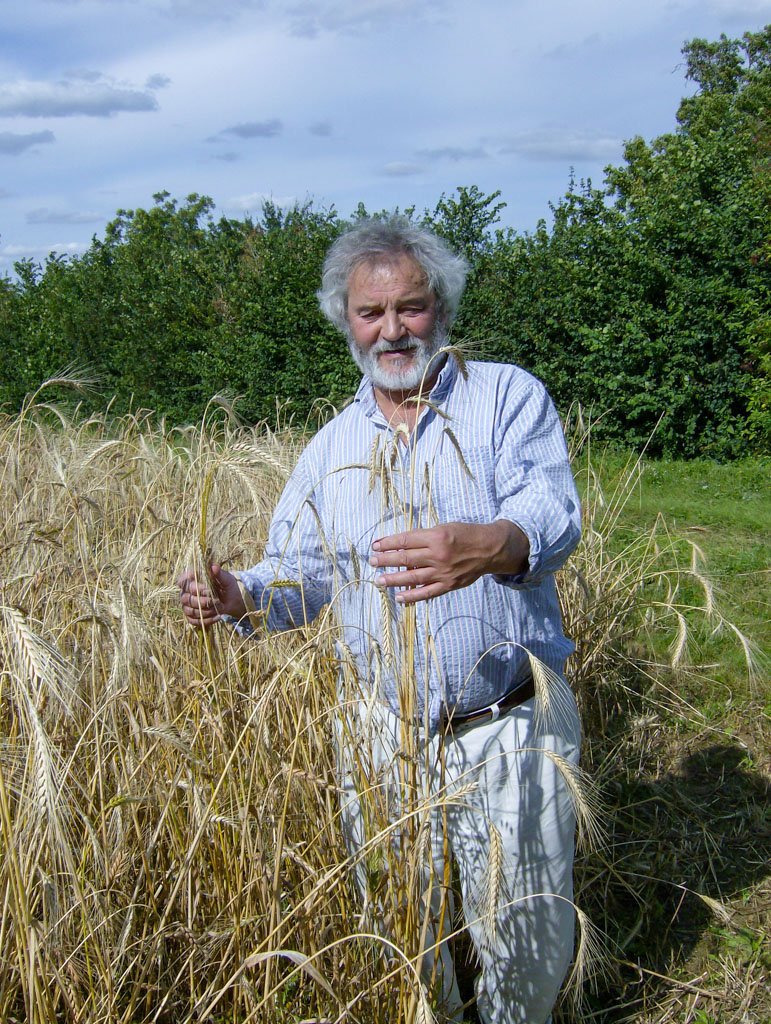
The pic — of me (CT) among some of John Letts’ Heritage wheat in Buckinghamshire — encapsulates some of the prime themes of The Great Re-Think. For John raises genetically diverse cereals on soils of low fertility year-on-year: no fertilizer, no pesticide, no herbicide, no digging, no fallow, and all wonderfully wildlife-friendly: key principles of agroecology applied to arable. All this is the complete opposite of the modern, industrial trend — monocultures of uniform crops chemicalized to the hilt. To rescue the world at this late hour we need to apply such radical thinking to all aspects of life.
Recent comments
I am writing this email from Torino in Italy. I came here to participate in the 40th anniversary celebration of…
Thank you, Colin, for this epic review. The absurdity of the modern condition demands such an approach. It is sobering…
This blog is at the root of our relationship with ‘life’ – human, more than human, non human – however…
My old granny always used to throw scraps of bread onto the lawn for the birds. She liked to watch…


Hi Colin. I read your recent blog with great interest. Diverse polycultures are the best way to do agriculture at…